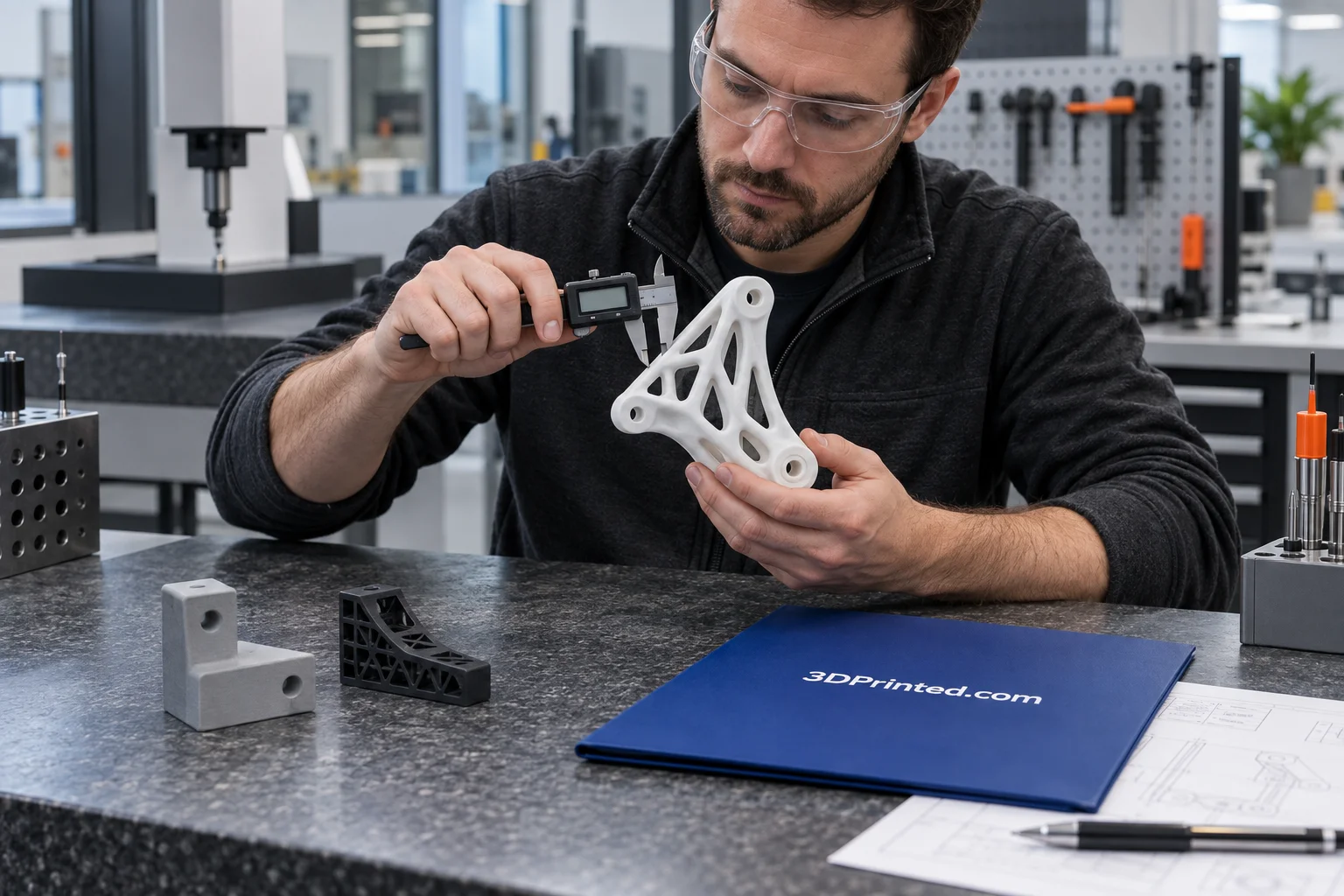
Teams often reach the same early question from different directions: could additive manufacturing make sense for this part? A useful answer is rarely a quick yes or no. It is a map of the intended use, the current manufacturing problem, the candidate process, the missing evidence, and the people who need to review it. 3DPrinted.com could become an application intelligence desk that publishes those maps as source-dated dossiers. This is an illustrative business concept for a future owner, not a live engineering service or an assurance that a part is suitable for production.
The past-tense word in 3DPrinted.com puts a physical result at the center of an application desk. A dossier could start with a reported printed part and work backward through its intended use, sources, process, and unanswered questions. That makes the address a fit for examining what an application actually demonstrates across industries, with the evidence policy establishing which conclusions a reader can draw.
Triage the decision before selecting technology
The desk's first offer could be a short application dossier for manufacturing leaders, product teams, and service providers. It would begin with the job rather than a machine. What does the part do? Is it a visual prototype, a manufacturing aid, a replacement component, or an end-use product? Which loads, environments, interfaces, tolerances, surfaces, and records matter? What does the existing method do well, and what problem is the team trying to solve?
NIST's overview of additive manufacturing and 3D printing lists legitimate uses that include prototypes, molds, tooling, lower-volume production, and components across several industries. Those examples show the range of applications. They do not establish that one process, material, or supplier fits a visitor's part. The desk would use examples to frame questions, then return to evidence specific to the intended use.
Triage should produce one of several bounded outcomes: worth a provider feasibility discussion, missing basic information, likely better examined against a conventional route, or outside the desk's editorial scope. None is a final engineering decision. A useful dossier makes the reason and remaining questions visible so the next reviewer does not have to reconstruct the starting point.
Give each dossier the same spine
A repeatable dossier could contain seven sections. First is the application and intended use. Second is the current baseline, including the process being compared and the reason for considering a change. Third is the design state and known requirements. Fourth is the candidate additive process and material class, clearly labeled as a hypothesis if no specialist has reviewed them. Fifth is the evidence record. Sixth is a list of unresolved questions with an owner for each. Seventh is the next decision and update date.
Every material claim would carry a source, publication or revision date, and a short note about scope. Primary research, standards, regulator material, equipment documentation, and provider statements should not be blended into one authority level. A provider statement can establish what the provider declares. It cannot by itself establish how a finished part will perform in the visitor's use.
The public dossier should also say who reviewed the interpretation and what they reviewed. A named editor may organize sources and note open questions. A qualified technical reviewer may assess a narrower section. If no relevant specialist has reviewed a point, the page should say so rather than borrowing credibility from the rest of the document.
Keep application classes separate
Prototype, tooling, end-use, and safety-critical work have different evidence burdens. A visual prototype may help a team evaluate shape and access without representing production material behavior. A jig or fixture enters a real workflow and needs requirements tied to that use. An end-use part raises questions about repeatability, inspection, traceability, service conditions, and change control. Safety-critical or regulated work adds requirements that a general editorial desk should not interpret on its own.
These categories are not a ladder where every project should climb toward production. A prototype may complete its job as a prototype. A manufacturing aid may deserve its own controlled lifecycle. A replacement part may be a poor candidate once consequence and evidence needs are understood. The desk creates value by preserving those distinctions instead of turning every case study into an adoption story.
NIST's measurement science research points to process variability, part accuracy, surface quality, material consistency, monitoring, inspection, and qualification as active concerns. A dossier can use those topics as an evidence checklist. It should not cite NIST as if the agency had evaluated the specific part or endorsed the desk.
Work through a modest example
Imagine a small manufacturer considering a printed assembly locator used at a bench. This is a hypothetical example, not a tested part or recommendation. The current locator is machined in occasional batches, and the product geometry changes often enough that the team wants to examine another route. The locator does not become a low-consequence item merely because it is called tooling. Its failure modes and workplace use still need review by the team responsible for the process.
The dossier begins with geometry, locating surfaces, expected handling, surrounding temperatures and chemicals, desired service interval, change frequency, inspection points, quantity, and the baseline cost and lead-time method the company trusts. It records which details are known and which remain estimates. The editor then gathers primary material about candidate process families and asks a provider what design and drawing information is needed for a feasibility review.
The dossier does not announce that printing will be faster or cheaper. It sets up a comparison. Could design consolidation remove an assembly step, or would post-processing add one? Can the relevant locating features be produced and inspected consistently? Would the team benefit from fast design revision, or would a stable conventional tool be easier to control? Which samples and measurements would support the next decision?
The result might be a plan for a limited prototype trial with inspection points defined in advance. It might instead show that the requirements are too incomplete to quote responsibly. Both outcomes are useful. The dossier has converted a broad technology question into a review that engineering, quality, operations, and a prospective provider can challenge.
Show the evidence chain
A claim table could pair each important statement with its source and decision use. One row might record that a process family can create the relevant geometry in principle, based on a primary technical source. Another might capture a provider's declared machine envelope. A third might show that the company has not yet defined an acceptance method for a key dimension. Readers could then see which rows describe general possibility, commercial capability, or application-specific proof.
Updates should be append-only where practical. If a source changes or a reviewer corrects an interpretation, the dossier would retain the prior date and explain the revision. A visible "reviewed through" date helps a reader judge freshness. Pages that cannot be maintained should move to an archive state rather than looking current indefinitely.
The America Makes Additive Manufacturing Adoption Playbook links process families with design, business case, workforce, readiness, and qualification. An intelligence desk could reflect that connected decision structure without reproducing the playbook's worksheets or treating it as a verdict on a particular application.
Draw a firm line around regulated uses
Some applications require sector-specific controls and qualified interpretation. The FDA's public example of the 3D-printing medical-device process moves through design, software preparation, material controls, printing, post-processing, verification, and testing. That source is useful as an example of a connected manufacturing evidence chain within its own medical-device context. It does not grant blanket material approval, provide clinical advice, or transfer a regulatory pathway to another part.
A general desk should keep medical and other safety-critical examples incidental and source-bound. It could identify that specialist review and applicable standards are required, then stop. It should not publish personalized suitability conclusions, select a regulated pathway, or let a disclaimer stand in for qualified work. An operator that later enters a regulated vertical would need dedicated expertise, review authority, and governance designed for that scope.
Publish for decisions, not headlines
The editorial product could include concise public dossiers, deeper member briefings, and private research assignments with a stated scope. Each format would use the same evidence labels and conflict policy. A private client should not be able to buy an unsupported favorable conclusion. If commercial support affects a dossier, readers need a clear disclosure and editorial separation.
Distribution could start with two strong public pilots: one prototype or fixture case and one end-use question that stops at the evidence gaps. Industry newsletters, manufacturing educators, design consultants, and provider teams could share a dossier because it gives their audience a practical question set. A short workshop could ask participants to challenge the dossier and identify missing evidence. That feedback becomes part of the revision record.
The first operating team would need an editor who can manage sources, technical reviewers for defined topics, a correction process, conflict disclosures, revision tracking, and a policy for work it will decline. Performance should be judged by source completeness, useful reviewer corrections, decision questions resolved, and whether readers can distinguish possibility from proof. Page views alone would reward the wrong behavior.
A future owner could begin with two dossiers built entirely from attributable primary sources and explicit limitations. That narrow pilot would test the method before any broad application database is promised. To discuss acquiring 3DPrinted.com for an application intelligence desk, use the inquiry form and describe the intended industries, review team, and evidence policy. Partnership proposals should name the technical interpretation the operator can responsibly provide and the areas it would route elsewhere.