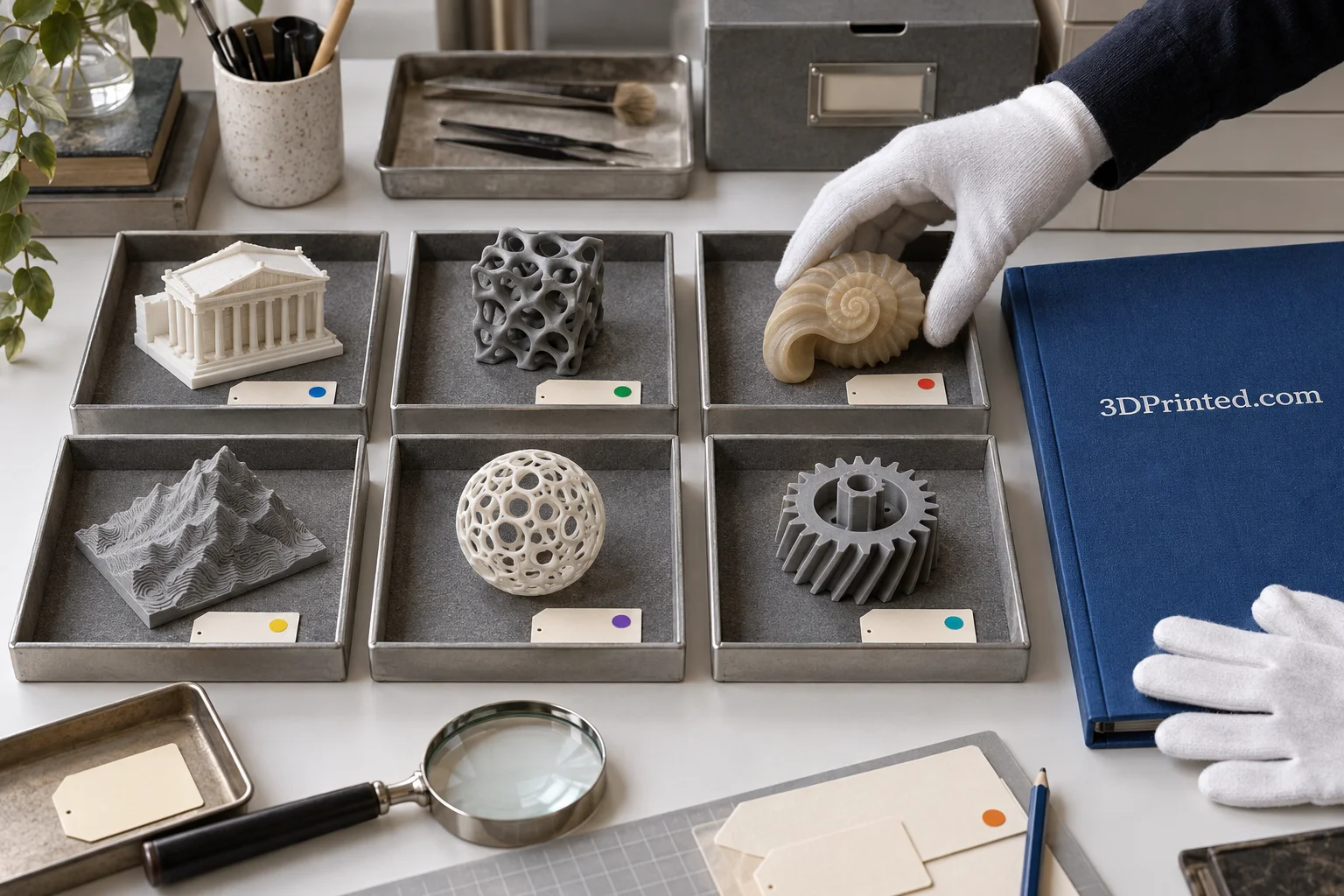
A downloadable model is much more useful when a learner can tell where it came from, which version is current, what permission accompanies it, and what happened when someone tried to prepare it for printing. 3DPrinted.com could support a curated library built around that record. This is an illustrative business concept for a future owner, not an operating repository, a rights-clearance service, or a promise that any file is safe or suitable to print.
For this library, 3DPrinted.com points to what happens after a digital model is downloaded. That connection gives preparation notes and documented print attempts a natural place beside origin, licensing, and version history. The name does not identify a file format or one teaching subject, so a collection could span mechanical demonstrations and classroom geometry while keeping the record of each physical result central.
Treat context as part of the model
The first customer could be an instructor, makerspace manager, or research group assembling a small teaching collection. Their problem is not a shortage of files. It is the time required to understand a file well enough to use it responsibly. A polished thumbnail and a download count do not answer who created the geometry, what changed between releases, or whether a print note came from an actual attempt.
Every library record could begin with five blocks: origin, rights, version, preparation, and learning context. Origin names the contributor and explains whether the geometry was designed digitally, derived from another model, or produced from measured or scanned material. Rights records the contributor's license declaration and any upstream attribution. Version identifies a stable release and change history. Preparation covers units, scale, orientation, supports, process, material, software, and machine context supplied by the contributor or a tester. Learning context explains what the model is intended to demonstrate.
These blocks should remain separate because they carry different kinds of confidence. A contributor may be authoritative about origin while a later tester supplies the print record. A curator may check that required fields are present without confirming ownership or guaranteeing performance. Each statement needs an author, date, and status rather than one broad "verified" badge.
Start with one learning vertical
An initial collection could focus on classroom geometry and simple mechanical demonstrations: sectioned solids, linkage models, fit examples, and measurement exercises. That boundary gives reviewers a coherent submission form and lets search follow real teaching tasks. It also avoids launching as a general upload site where moderation, rights, and technical context become unmanageable on the first day.
The operator would work with a small group of instructors and makerspace staff to define the minimum record. What does a learner need before opening the file? Which notes help an instructor judge whether the model fits a lesson? Which machine details explain an observed result without implying that every user will reproduce it? These questions can be answered through a pilot collection before software work expands.
NIH 3D provides an institutional precedent for sharing models and resources with scientific, research, and educational context. That precedent does not endorse this concept, and a classroom-mechanics library would have a different subject and review policy. It does show why the surrounding information can matter as much as the download itself. Any biomedical material, if considered later, would require a dedicated policy and qualified review rather than being mixed casually into the starter collection.
Make provenance readable
A provenance panel should tell a short, inspectable story. It might say that an instructor submitted an original linkage model, selected a stated license, published version 1.0 on a particular date, and later released version 1.1 after correcting a mislabeled part. If the file adapts an earlier work, the panel should link to that work, name the modification, and preserve the upstream notice supplied with it.
The platform should never imply that a completed form settles every rights question. A contributor-permission workflow can require an affirmation that the uploader has authority to share the material and can collect the information needed for attribution. It cannot replace legal review where ownership or permitted use is disputed. The library would need a clear notice process, a way to suspend a contested file, and a public correction trail when metadata changes.
Stable releases help teachers and researchers cite what they used. Each release could receive a version identifier and file hash while the record preserves earlier versions. A new upload should not silently replace a file linked from a lesson plan or research note. If a serious problem requires removing access, the public record can explain that a release was withdrawn without continuing to distribute it.
Separate a print record from a guarantee
A print note should describe an observed attempt. It might list the file version, preparation software, relevant settings, machine class, material named by the tester, orientation, supports, post-processing, date, and result notes. Photos can document what the tester saw. The record should avoid phrases such as "prints perfectly" because a single attempt cannot establish a universal outcome.
NIST explains additive manufacturing as a digital-design and layer-building process used with multiple material classes. The library could use that high-level framing to organize preparation records while making clear that details do not transfer automatically between process families, materials, machines, or environments.
A helpful interface would distinguish contributor notes, curator checks, and community print records by color and label. Community members could report a mismatch, attach a permitted photo, or propose a correction. Curators would review the report and record the decision. Popularity should not decide whether a technical correction is accepted. The evidence and the stated scope should.
Work through an illustrative release
Imagine a teacher submitting a small gear-train model for a lesson on motion and ratio. This is a hypothetical example, not a real file or validated classroom result. The submission includes separate part files, an assembled reference model, units, a diagram of the intended relationships, and a note that learners should measure the parts before assembly. The teacher identifies the work's origin and selects a license through the submission form.
Version 1.0 enters review. A makerspace tester notices that the diagram uses an older part label, while the geometry itself opens correctly in the chosen preparation software. The curator returns the record for correction rather than editing the contributor's file without explanation. The teacher submits version 1.1 with the label fixed, and the release history states exactly what changed.
A second tester reports that a supplied orientation note was used on a different machine and material, then records the observed fit without claiming a general result. The page now gives an instructor something far better than an anonymous upload: an accountable origin, a version to cite, the contributor's rights statement, a correction history, and bounded print observations. The instructor still decides whether the model and activity suit the class.
Design discovery around the reader's task
Search should go beyond file format and subject tags. A learner may need a model for understanding a mechanism, practicing measurement, comparing surface outcomes, or learning preparation choices. An instructor may want models with a lesson note, a stable release, or at least one documented print record. A researcher may care about origin, modification history, and a citable version. Those are useful filters because they map to actual work.
The America Makes adoption playbook presents additive manufacturing through multiple process families and connects technical selection to design, readiness, and qualification. A learning library can borrow the discipline of distinguishing processes and decisions without copying its worksheets or presenting a teaching file as a qualified production design.
Distribution could begin through instructors, makerspace coordinators, and institutional collection managers who contribute a small themed set. A public submission clinic could walk contributors through origin, rights, version, and print-note fields. A downloadable record template would help potential users evaluate the method before they commit a collection. The strongest early promotion would be one exemplary record, not a large count of loosely documented uploads.
Plan for moderation before opening submissions
The operator would need an acceptance policy, contributor terms, rights and attribution fields, correction and notice routes, reviewer roles, prohibited-content rules, and a record-retention plan. Reviewers need a playbook for incomplete origin stories, disputed permissions, broken archives, misleading print claims, and personal information embedded in files or metadata. Edge cases should go to a named decision owner rather than disappearing into a generic queue.
The first pilot could publish a few dozen models from invited contributors in one learning vertical. Success measures might include complete provenance records, time to resolve corrections, use of stable versions in lesson materials, and whether outside readers can explain the difference between a contributor claim and a documented print record. Those measures test the library's clarity and stewardship, not the performance of any teaching program.
A provenance-first library would make the history around a model part of what visitors come to find. A future owner could pair free public records with paid collection management or institutional curation only after validating the workflow and its rights boundaries. To discuss acquiring 3DPrinted.com for this direction, submit an inquiry describing the initial collection, contributor community, and review plan. Partnership proposals should identify who would operate moderation, permissions, and version stewardship.