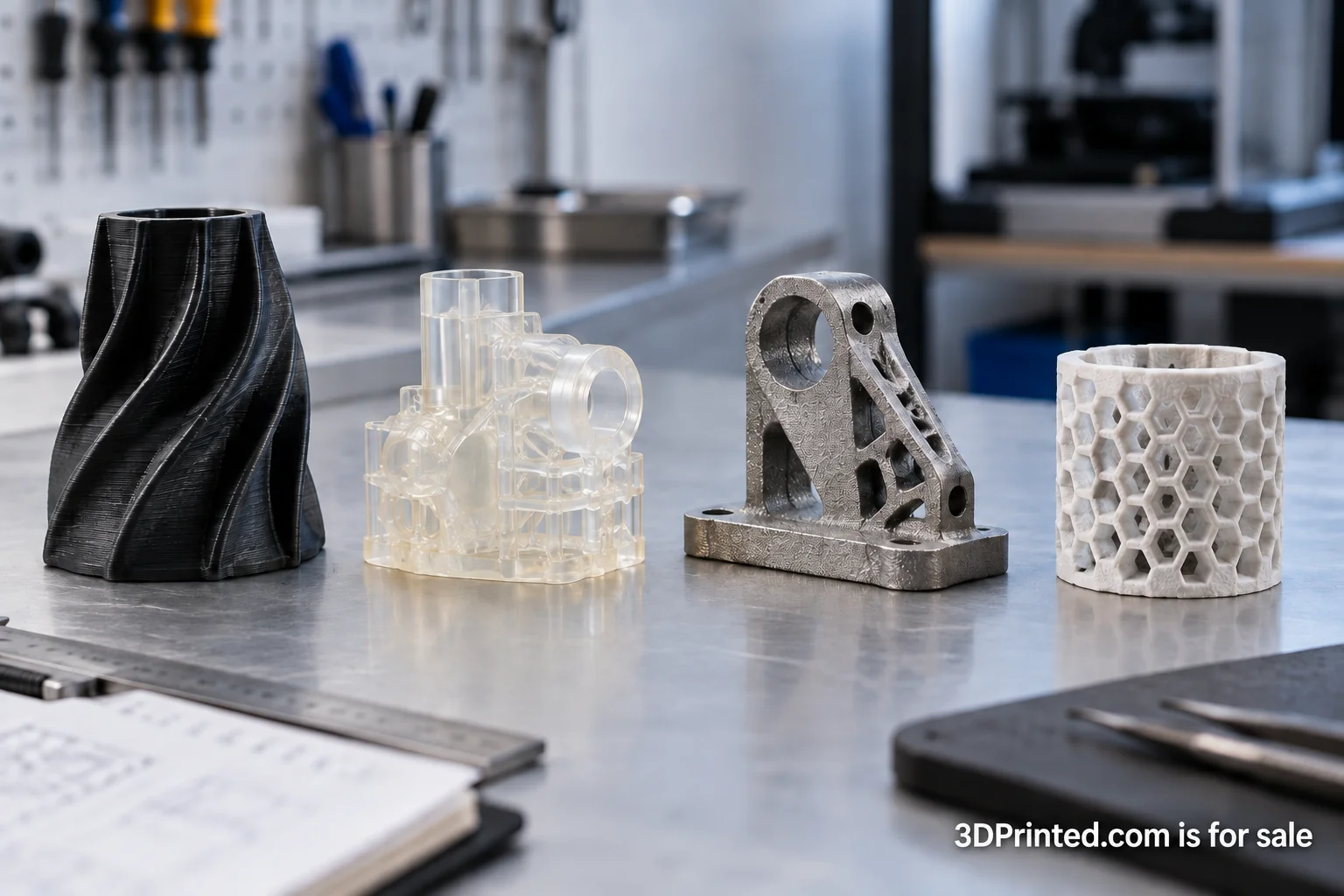
If one person says 3D printing and another says additive manufacturing, they may be talking about the same basic way of making a part. They may also be signaling different levels of detail, different audiences, or different stages of a manufacturing program. The useful move is not to police the label. It is to find out what process, material, part, and evidence the speaker actually means.
The shared idea is straightforward. A digital design guides the creation of physical three-dimensional geometry through successive additions of material. NIST explains the process in contrast with methods that cut material away or form it in a mold. That common foundation is why 3D printing and additive manufacturing overlap so often in ordinary conversation. It is also why the words alone cannot tell you whether a proposed method fits a particular job.
The short answer
Use 3D printing when plain language helps people understand the activity or the resulting printed object. Use additive manufacturing when a technical, industrial, standards, or production conversation needs a broader process frame. Treat this as a communication choice, not a universal rule that divides two separate technologies.
Public authorities show that range in practice. The current ISO/ASTM 52900 terminology record uses additive-manufacturing language for fundamentals and vocabulary. NIST publishes material under both additive manufacturing and 3D printing. The FDA uses 3D printing in public guidance about medical devices while describing a controlled manufacturing sequence. Those choices do not create three competing definitions. They show how context shapes the useful label.
A good technical description usually adds the missing nouns: the process family, feedstock or material, machine, build preparation, post-processing plan, inspection method, and intended use. If those details are absent, replacing 3D printing with additive manufacturing does not make a proposal more complete.
What both terms have in common
Both terms begin with digital geometry. A model is prepared for a selected manufacturing route, the equipment builds the geometry by adding material, and the printed result moves through whatever finishing and verification the application requires. The route is digital-to-physical, but it is not a single-button journey.
The America Makes Additive Manufacturing Adoption Playbook treats additive manufacturing as several process families rather than one uniform technique. It connects process and material selection with design, the business case, organizational readiness, and qualification. That matters because two parts described as 3D printed can come from different process families, use different materials, and demand very different finishing or evidence.
Keep this distinction: the category name describes a way of building geometry, not a complete part specification. It does not establish accuracy, surface condition, strength, repeatability, cleanliness, cost, or suitability. Those questions require part-specific requirements and evidence.
The full chain hidden inside a familiar phrase
A phrase such as send it to the printer compresses a series of decisions. A useful digital-to-physical map looks like this:
- Define the job. Is the output a visual model, a fit-check prototype, a shop aid, tooling, or an end-use component? What must it do, and what happens if it does not?
- Control the design. Identify the approved geometry, revision, interfaces, tolerances, and any features that need special attention.
- Prepare the build. Convert and arrange the design using the software and settings required by the selected route. Record the version that is actually sent forward.
- Match process and material. Choose a process family and material system that can be evaluated against the part's requirements. A category label is not a substitute for this choice.
- Fabricate the part. Build it under defined conditions, with the records appropriate to the intended use.
- Complete post-processing. Remove supports or residual feedstock, finish surfaces, apply any required treatments, and protect critical features. The exact work depends on the route and requirements.
- Verify and release. Inspect, test, document, and decide whether the finished part meets its acceptance criteria.
The FDA's public example of a 3D-printing workflow is useful because it names design, software preparation, material controls, printing, post-processing, verification, and testing as connected stages. That page concerns medical devices, so it should not be treated as a universal production recipe. The transferable lesson is narrow: the printer is one stage in a controlled chain, not the whole chain.
Where the words are most useful
The following comparison is a communication aid, not a standards definition.
| Situation | Usually clearer opening term | Detail to add immediately |
|---|---|---|
| Explaining the idea to a general audience | 3D printing | What is being made and why |
| Discussing a hobby or classroom object | 3D printing | Machine, material, supervision, and safe-use limits |
| Comparing industrial process routes | Additive manufacturing | Process family, material system, geometry, and volume |
| Writing a manufacturing requirement | Additive manufacturing | Applicable specification, controlled parameters, inspection, and acceptance |
| Talking about a prototype | Either | What question the prototype must answer |
| Discussing a regulated or safety-sensitive part | The term used by the applicable authority or program | Intended use, requirements, evidence, and review responsibility |
The right-hand column carries the useful detail. A team can use the preferred term and still misunderstand the project if it has not agreed on the part's purpose or the evidence needed after the build.
Prototype, tooling, and production are different conversations
NIST's manufacturing overview lists uses that include prototypes, tooling, lower-volume production, jigs, automotive spares, aerospace components, prosthetics, and dental appliances. That range shows why a single label cannot carry the whole decision. The examples identify legitimate application areas, but they do not show that any process or supplier suits any particular part.
A prototype may exist to answer one narrow question: Does the shape fit the available space? A jig may need repeatable interfaces and durability within a defined shop task. An end-use component may need documented material, dimensional, functional, and traceability evidence. Calling all three 3D prints is understandable. Treating them as the same procurement problem is not.
Medical and aerospace examples belong at the edge of a general explanation, not at its center. They demonstrate that additive routes can appear in demanding sectors. They do not confer approval, certification, or performance on a material, machine, provider, or finished part. For those applications, the responsible team must follow the applicable standards, regulator, quality system, and qualified review.
A six-question terminology check
Before researching equipment or asking a provider for a quote, answer these questions in writing:
- What is the intended output? Name the part or artifact and its job.
- Which stage is this? Exploration, prototype, tooling, bridge production, or ongoing production should not be blended without explanation.
- What must be true of the finished item? List interfaces, dimensions, surface needs, environment, and functional expectations that matter.
- Which process and material are actually under consideration? If they are unknown, say that the project is still screening options.
- What happens after fabrication? Identify finishing, cleaning, treatment, assembly, inspection, or testing that may be part of the delivered result.
- Who decides acceptance? Name the person or function responsible for the requirements, evidence review, and release.
If these answers are available, the vocabulary question usually becomes easy. If they are unavailable, debating the preferred category term is premature.
A worked example: one bracket, two jobs
Imagine a team considering a printed bracket. In the first job, the bracket is a visual and fit-check model used at a design review. The team can say 3D-printed prototype, name the proposed material and process, and state the dimensions it wants to check. The prototype does not become production evidence merely because it resembles the final geometry.
In the second job, a bracket with similar geometry is intended for repeated service in equipment. Now the description needs to expand. The team must define the service conditions, interfaces, material and process requirements, finishing steps, inspection, testing, records, and change controls appropriate to that use. Additively manufactured production part may be the more natural phrase, but the extra words do not qualify it. The evidence chain does.
The example does not assume that printing is the best route for either job. It shows how intended use changes the questions. A manufacturing team should still compare additive options with other feasible methods, along with lead time, quantity, design needs, supplier capability, and total downstream work.
How to read claims without being distracted by the label
When a vendor, article, or internal proposal uses 3D printing or additive manufacturing, look for the claim behind the term. A statement about faster iteration may concern prototypes. A statement about production may depend on a specific process, material, geometry, quantity, and inspection plan. Ask what evidence supports the stated context rather than transferring a result from one application to another.
Watch for three shortcuts. First, a photographed finished part is not proof of repeatable conformance. Second, a material family name is not a complete material specification. Third, a list of industries served does not establish qualification for your part. These are reasons to ask for precise records, not reasons to dismiss the technology.
A practical next step
Write a one-paragraph job statement before searching for a process. Start with: We need a prototype, tool, or production part that performs this function, in this environment, with these interfaces, and we will judge it using these checks. Mark unknowns plainly. Then ask potential providers or internal specialists which process families and materials deserve evaluation.
Use 3D printing when it makes that conversation accessible. Use additive manufacturing when it matches the technical setting. In either case, attach the details that turn a broad category into a reviewable manufacturing plan.